
Hormonal birth control can affect more than pregnancy prevention, especially for women with ADHD. This article explores how contraceptives may influence focus, mood, medication effectiveness, and overall well-being, helping you make more informed choices about your health and treatment.



This article was developed by Yann Ghisalberti (Coach4ADHD) in collaboration with the 3mbrace Health team and reviewed by Dr. Deyo Famuboni.
For many women with ADHD, that question hits close to home.
Hormonal birth control is often prescribed to manage periods, acne or Premenstrual syndrome (PMS) but it also changes how your brain’s chemistry works. And for people whose focus and emotions already fluctuate with hormonal shifts, that can make a real difference.
In this post, we take a deep dive into how hormonal birth control can affect ADHD symptoms, medication, and mental well-being and what to keep in mind when choosing the right option for you.
ADHD is often discussed through the lens of dopamine, the neurotransmitter that helps us focus, plan, and feel motivated. But dopamine doesn’t work alone. It’s part of a delicate hormonal orchestra, influenced by estrogen and progesterone.
Estrogen supports dopamine and serotonin activity in the brain which means that when estrogen levels rise (as they do before ovulation), many women with ADHD notice sharper focus and more emotional balance.
When estrogen and progesterone fluctuate (especially before the period), ADHD symptoms like forgetfulness, irritability, or low motivation often get worse (Source MDPI). This isn't just a 'feeling' or an excuse; it's a biological reality. However, a recent systematic review indicates that while there are strong associations, more research is needed to make conclusive statements, as not all studies find the exact same link.
That’s why so many women say: “My ADHD feels worse right before my period.”
Hormonal birth control changes that natural rhythm for better or worse by flattening or altering these hormonal peaks and dips.

Because each method delivers hormones differently, the effects on mood, focus, and ADHD symptoms can vary widely from person to person. The effects may vary widely not only because of the method of delivery but also due to individual variability.
Many women with ADHD are already more sensitive to emotional ups and downs. Studies show that hormonal contraceptives can influence mood and that women with ADHD may be especially vulnerable.
The fivefold increase is in comparison to those without ADHD who were not using the combined oral contraceptive pill (COCP).
👉 PubMed: Association of ADHD and Oral Contraceptive Use With Depression Risk
Important Note: Study's limitations shared by the author Skoglund: "It may be that, when taking oral birth control, women with ADHD might be extra susceptible to forget to take their birth control pills or may take them irregularly, causing hormonal fluctuations that may destabilize mood."
Many clinicians now recognize that hormonal contraceptives can cause mood changes, especially in people with pre-existing ADHD or mood vulnerabilities. (Frontiers in Global Women’s Health, 2025).
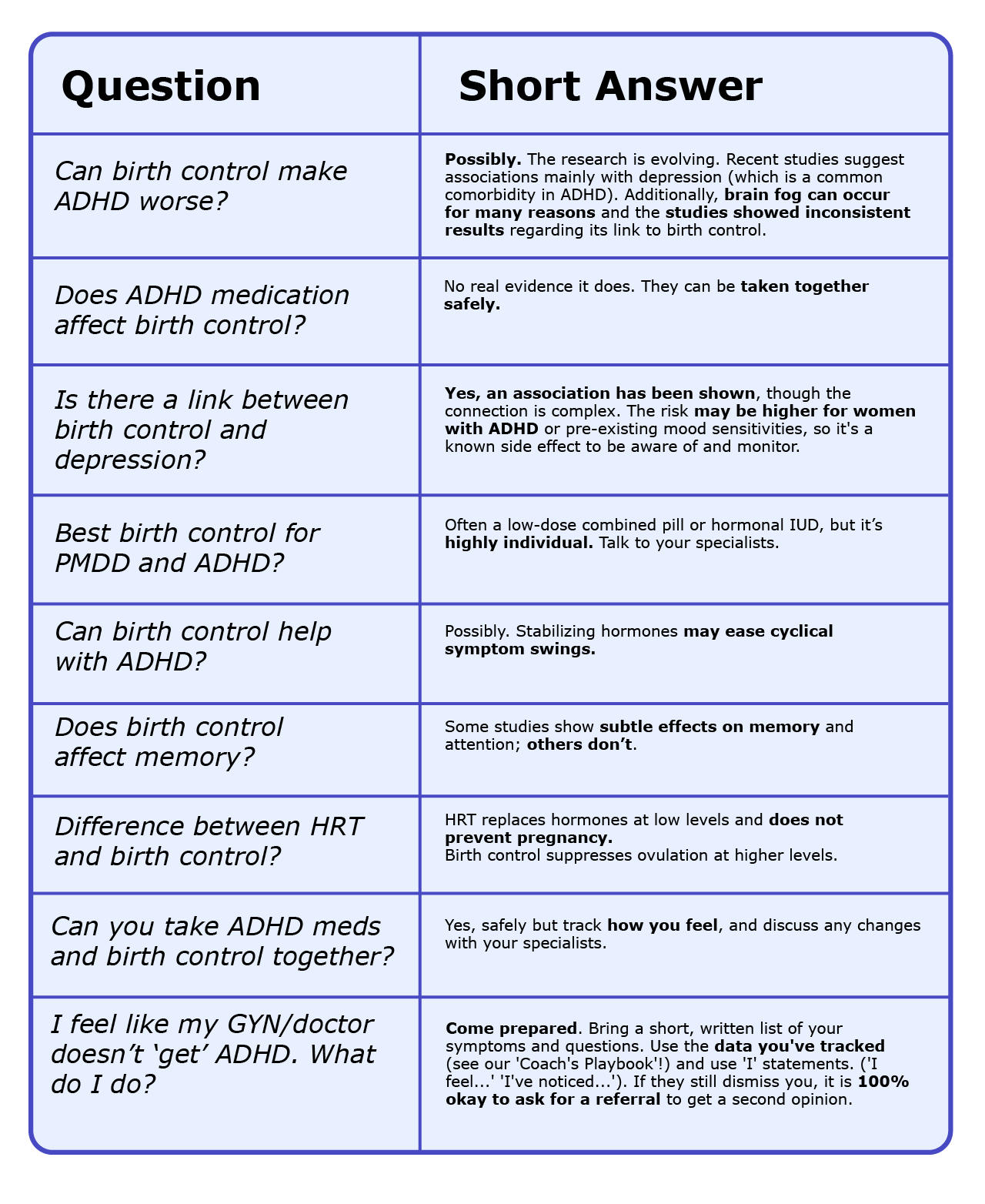
So if you’ve ever wondered, “What’s the connection between birth control and depression?” The answer is complex, but a link does exist. Studies show an association with depression, especially in women with ADHD. It's a known side effect to be aware of and monitor.
Tip: Track your mood for a few months after starting a new contraceptive method. If you feel consistently lower, more anxious, or emotionally flat, bring it up with your doctor as you may do better on a different formulation or non-hormonal option.
Many women with ADHD describe experiencing “brain fog” on certain birth control methods, feeling slower, unfocused, or like their mind is wrapped in cotton. This 'brain fog' is a direct hit to our executive functions, the very skills we already work so hard to manage.
Science is still catching up, but early findings suggest that hormonal contraception can subtly alter brain function.
So, if you notice that your memory, focus, or motivation shift after starting birth control, you're not imagining it. Hormones literally shape how your brain processes information.
What about using Stimulants as ADHD medication, like lisdexamfetamine (Elvanse) or methylphenidate (Ritalin) with birth control?
Good news! There’s no real evidence that stimulants make hormonal birth control less effective, or vice versa. (Source Healthline - ADHD and Birth Control - What to Know)
Still, there are a few things to consider:
Every person reacts differently to stimulants, hormones, and birth control. If you start a new contraceptive and feel fine, your treatment plan is working! But if you become symptomatic (noticing your ADHD meds feel weaker, your mood drops, or your brain fog intensifies), bring your symptom tracker to your GP. If they are unsure how to manage the interaction, that is the perfect time to ask for a referral to a psychiatrist or an ADHD nurse.
In short: You can take ADHD meds and birth control together but pay attention to how your body and brain respond. And always talk about it with a specialist to find what works for you.
The link between ADHD and severe premenstrual issues isn't just a feeling!
It's now strongly supported by research. A 2025 study from The British Journal of Psychiatry revealed that women with ADHD are over three times more likely to develop PMDD (Premenstrual Dysphoric Disorder) than women without ADHD.
PMDD is an extreme form of PMS, and this connection is critical: Both PMDD and perimenopause are characterized by significant estrogen fluctuations.
Because estrogen helps support the dopamine system, these hormonal shifts can drastically worsen ADHD symptoms, often leading to severe brain fog, memory issues, and emotional dysregulation that feel unmanageable.
This is why hormonal birth control is sometimes used to smooth those hormonal ups and downs of PMDD or perimenopause, both of which can intensify ADHD symptoms.
Certain low-dose combined pills or continuous dosing (skipping placebo weeks) can help stabilize mood swings. But for some, progestin-heavy methods make anxiety or irritability worse.
If you’re in perimenopause, note that birth control and HRT (Hormone Replacement Therapy) aren’t the same. Birth control uses higher hormone doses to prevent ovulation and pregnancy. HRT uses lower, more natural doses to replace declining hormones and manage menopausal symptoms. And HRT does not prevent pregnancy.
Hormonal birth control and ADHD is a growing field of study — but still one with many open questions. Here’s what we know:
✅ Depression risk appears higher in women with ADHD who use hormonal contraceptives. (PubMed 36332846)
✅ Cognitive effects vary. Some experience brain fog; others notice no change or even improved consistency.
✅ Medication safety: ADHD medication generally doesn’t interfere with birth control, but symptom tracking is key.
✅ Individual response is everything. There’s no universal “best birth control for ADHD.” What helps one woman focus might make another feel off-balance.
✅ Higher Unintended Pregnancy Risk: Women with ADHD have a higher rate of unplanned pregnancies. This is often because it's harder to remember a daily pill and due to a higher tendency for impulsive sexual risk-taking. This also leads to a greater use of emergency contraception (the "morning-after pill").
Here are a few practical guidelines from both research and lived experience:
A Coach's Tip: Don't just track "mood." Get specific. Try a simple chart for 3 months:

P.S. Still feeling a bit foggy?
It might not just be the hormones! Contraceptive pills can sometimes cause subtle nutritional deficiencies that contribute directly to brain fog, a factor often overlooked in ADHD care. Keep an eye out for our next post, where we’ll break down the hidden link between nutrition, birth control, and your focus.
Sign up for our newsletter to be the first to get your hands on the latest on womens health in the workplace.


It’s time to create workplaces where women’s well-being isn’t just acknowledged but prioritized—because when women thrive, businesses succeed.
Join the movement
Whole Health Programs for Women and Employers
We help create healthier, more inclusive workplaces where women and businesses thrive.


.svg)